Part-Whole Number Bonds Worksheet Maker Create custom printable number bonds worksheets in seconds!

At a Glance

This interactive Part-Whole Number Bonds Worksheet Maker lets teachers and parents generate custom printable practice sheets for Pre-K through Grade 3. Choose any target number, select which part of the diagram to leave blank, pick your problem count, and download a PDF with an optional answer sheet - a fast, flexible way to build number sense and early math fluency.

About the Part-Whole Number Bonds Worksheet Maker

If you’ve been searching for a quick, flexible way to create number bonds worksheets without spending half your Sunday on it, you’ve come to the right place! And even if you haven’t, you still may be happy to found us.

The Part-Whole Number Bonds Worksheet Maker lets you build fully customized, print-ready number bonds worksheets in seconds.

Choose your target number, pick the part you want to be missing, tweak a few options, and hit generate. Your worksheet (and answer sheet!) are ready to download as a crisp PDF before you’ve even finished your coffee.

Whether you’re a teacher prepping morning work for a whole class or a parent sitting down with your little one at the kitchen table, this tool has got you covered!

What Are Number Bonds and Part-Whole Models?

part part whole number bonds worksheet creator - printable custom pdf - fill in the blanks, fact families and number sentences

You might have heard both terms before, you might not – but either way, here’s a brief explainer:

A number bond is simply a pair of numbers that add together to make a given total. The number bonds to 10, for example, are all the pairs that add up to 10: 1 and 9, 2 and 8, 3 and 7 and so on. They are also sometimes called fact families or math facts, and they demonstrate the part-part-whole relationship of numbers.

A part-whole model (also sometimes called a cherry diagram – you’ll see why!) is the visual way of showing those relationships. There’s one circle at the top for the whole, and two circles hanging below it for the parts, connected by lines.

The whole is written in the top circle, with the parts below. It’s a lovely way for your little learners to start visualizing some core math concepts.

Why This Tool Is Awesome

There are plenty of number bonds worksheets floating around the internet, but most of them are fixed – you get what you get. This tool is a bit different, and here’s why we love it:

Seven missing modes. Most worksheets just blank out one part. Here you can choose to hide the left part, the right part, either part at random, the whole number, a random mix of all three, everything (so children create their own bonds from scratch), or nothing at all (for display or guided work). 

Works for any number. Quick preset buttons for the most popular targets – 5, 6, 7, 8, 9, 10, 20, and 100 – plus a custom field for anything else you need. Number bonds to 15? Bond to 50? Go for it!

4, 6, 9, or 12 problems per page. The 4-problem layout gives young or struggling learners big, generous diagrams with loads of writing space. The 12-problem layout packs in focused practice for your more confident learners.

Optional number sentence below each diagram. Toggle this on and each diagram gets an addition sentence beneath it. 

Answer sheet included. One click to download a matching answer sheet.

Fact families on the answer sheet. Turn this on and the answer sheet shows all four related number sentences beneath each completed diagram – a really handy reference.

Black and white mode. Ink-friendly for those of us with busy classroom printers!

Ways to Use It in Your Classroom (and at Home!)

The flexibility of this tool means it works in a lot of different situations. Here are some ideas to get you started:

Morning work or warm-up. Print a 6-problem sheet as a quick independent starter. It takes most children just a few minutes and it’s a great way to keep up that number fluency.

Introduce a new target number. When your class moves from bonds to 10 to bonds to 20, generate a “Nothing – all filled in” sheet first. Children can study the completed diagrams, spot the patterns, and discuss what they notice before they ever try to fill one in themselves.

Differentiated practice, same topic. Generate a “Left Part only” sheet for children who need scaffolding and a “Mixed” sheet for those who are ready for more challenge.

With manipulatives. Print the “Everything blank” version and set out counters, cubes etc. Children can then physically practice making some objects and breaking them into parts – then record what they made on the sheet. Brilliant for hands-on learners and for bridging the gap between concrete and written work.
create number bond morning exercises - print off answer sheets with number sentences and fact families included!

Oh and I hope you notice the lovely font. That’s our own Early Readers font, that has been specially designed to keep the numbers clear and simple!

Well, I think that about covers it. 

Follow the instructions below to generate your own part-part-whole practice sheets!

And if you find it useful, to help get the word out could you please give it a little share or tell someone who you think would find it useful. Thanks!

How To Use

As with all the activity makers, I really want to make them as useful as possible, so there’s a few options for you to tailor it exactly as you want!

Step 1 – Give Your Worksheet a Title (Optional)

Type a title in the Worksheet Title field at the top. If you leave it blank, the tool will automatically use “Number Bonds to [X]” – totally fine for most uses!

Step 2 – Choose Your Target Number

Click one of the preset buttons – 5, 6, 7, 8, 9, 10, 20, or 100 – or type any number from 2 to 999 into the Other field. This is the whole that all your part-whole diagrams will add up to.

Step 3 – Choose What’s Missing

Pick from the dropdown:

  • Left Part – the left circle is always blank
  • Right Part – the right circle is always blank (bet you guessed that)
  • Either Part (random) – randomly blanks one part per problem
  • Whole – both parts are shown, children find the total
  • Mixed (random) – randomly blanks a part or the whole per problem
  • Everything – all three circles are blank so children create their own
  • Nothing – all filled in, great for display or guided discussion

Step 4 – Choose How Many Problems

Pick 4, 6, 9, or 12 problems. The 4-problem layout works especially well for younger or early-stage learners as the diagrams are nice and large.

Step 5 – Set Your Options (Optional)

Toggle on or off:

  • Number sentence – prints an addition equation beneath each diagram with a line for the missing value
  • Name line – adds a name field at the top of the worksheet
  • Answer sheet – enables the answer sheet download button
  • Fact families on answer sheet – when the answer sheet is on, this adds all four related number sentences beneath each completed diagram
  • Black and white – removes color for ink-saving printing

Step 6 – Generate!

Hit the big teal Generate Worksheet button. A preview of your worksheet will appear below. Check it looks right, then hit Download Worksheet to save your PDF. If you turned on the answer sheet, hit Download Answer Sheet for that too.

If you want to make another, hit the Make Another button to reset the tool and start fresh whenever you’re ready for a new worksheet.

Hope your little learners enjoy the number bond practice!

Hooray!

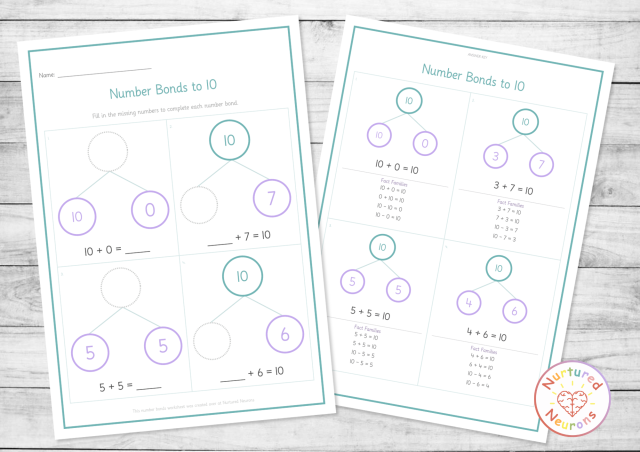
The custom number bonds practice sheets should look something like this:

A printable number bonds worksheet showing part-whole model diagrams with teal and purple circles. Each diagram has a whole number at the top connected by lines to two part circles below, with a number sentence underneath. Generated using the Nurtured Neurons Part-Whole Number Bonds Worksheet Maker.

Create your Part Part Whole Practice Sheets

Hope your little learners enjoy improving their math skills – scroll down to get started! Or check out our other worksheet and game makers here.

If you can’t see the sight word practice worksheet maker – it’s probably because you’re on a mobile device. You can try switching your device to landscape mode or if that doesn’t work, try again on a PC or laptop. 

Thanks!

You need to be a member to use this awesome tool - become a member today and get access to all of the teaching tools, plus a ready-to-go library of wonderful worksheets, awesome games, hands-on crafts and more!

Enjoy!

custom part whole worksheet maker - create your own number bond worksheets - printable pdf

FAQ

A part-whole model is a visual diagram used to show how a number (the whole) can be broken into two smaller numbers (the parts). It’s usually drawn as three circles – one on top for the whole and two below for the parts – connected by lines.

It’s one of the most commonly used methods for teaching early addition and subtraction because it makes the relationship between the numbers really clear at a glance.

Number bonds are the concept – the pairs of numbers that combine to make a given total. A part-whole model is a visual way of representing those bonds. So “3 and 7 make 10” is a number bond; the three-circle diagram showing that relationship is the part-whole model.

Number bonds are typically introduced in Kindergarten and Pre-K, starting with small numbers like bonds to 5 and bonds to 10. They can be introduced in the early elementary grades – Kindergarten, Grade 1, Grade 2, and Grade 3 – as students develop a stronger understanding of numbers and arithmetic operations. This tool covers all of those years, and the 4-problem layout is particularly well suited to the youngest learners.

Any whole number from 2 to 999! The preset buttons cover the most commonly taught targets – 5 through 10, 20, and 100 – but the custom field lets you go wherever you need.


For small target numbers, possibly yes. For example, bonds to 5 only has 6 unique pairs (0+5, 1+4, 2+3, 3+2, 4+1, 5+0), so if you ask for 9 or 12 problems the tool will tile the pairs and some will repeat. For bonds to 10 and above you’ll have plenty of unique pairs to fill any of the four problem counts without repeating.

The part-whole model naturally shows subtraction as well as addition – when children see the whole and one part, finding the missing part is subtraction, even if it’s not written as a subtraction equation. If you turn on the fact families option on the answer sheet, you’ll see all four related sentences including the two subtraction facts. A dedicated subtraction worksheet maker is also available separately!

Absolutely! Worksheets generated by this tool are for personal and classroom use. Print as many copies as you need for your students, use them for homework, assessments, centers – whatever works for you.

If you chose the “Everything – Create Your Own” missing mode, then yes, all three circles will be blank! That mode is designed for children to build their own number bonds from scratch. If that’s not what you wanted, pop back to the tool and choose one of the other missing modes.

Access all the activities today