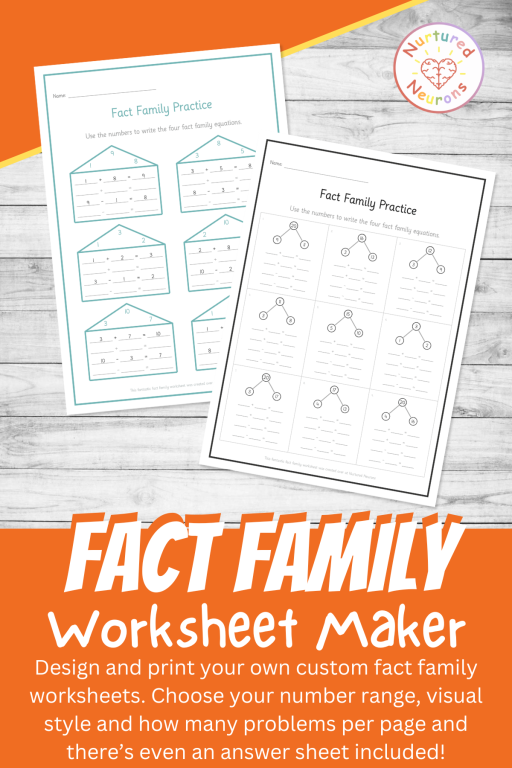
Custom Fact Family Worksheet Generator

At a Glance

This interactive Fact Family Worksheet Maker lets teachers and parents generate custom printable addition and subtraction practice sheets for Kindergarten through Grade 2. Choose from three visual formats - house, triangle, or part-whole model - set your number range, add scaffolding if needed, and download a PDF with a matching answer sheet in seconds.

About the Fact Family Worksheet Maker


This Fact Family Worksheet Maker is an awesome printable worksheet generator that lets you create custom fact family practice sheets in seconds!

You can choose from three visual layouts, set a number range and print off a super math worksheet before your coffee gets cold.

It’s designed for teachers and parents teaching with children in Kindergarten through about Grade 2 – though it works just as well for older learners who need a little extra practice with number relationships.

What Are Fact Families?
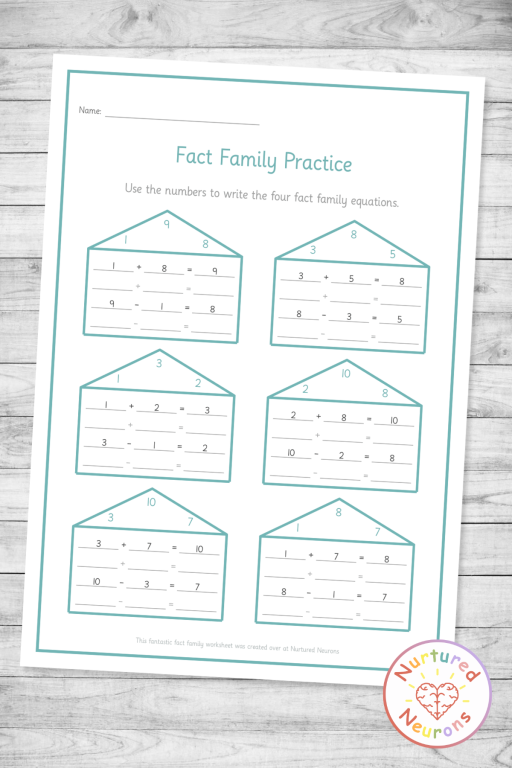
 

A printable fact family worksheet showing six house-shaped diagrams, each with three numbers inside the roof and four addition and subtraction equation lines in the body below, generated using the Nurtured Neurons Fact Family Worksheet Maker.

A fact family is a group of numbers that are connected through addition and subtraction or multiplication and division. This worksheet maker deals with addition and and subtraction – if there’s call for a multiplication/division one, I’ll see if I can make one as well.

Anyways, take the numbers 3, 5, and 8. Together they make a complete fact family:

  • 3 + 5 = 8
  • 5 + 3 = 8
  • 8 – 3 = 5
  • 8 – 5 = 3

That’s it – four number sentences, three numbers, one family. The activity on these worksheets is simple: children look at the three numbers shown in the diagram, then write the equations themselves. 

Why Are Fact Families Good for Your Little Learners?


They make the link between addition and subtraction concrete. Most young children learn addition and subtraction as completely separate things. Fact families show them that the two operations are actually two sides of the same coin – if you know 4 + 7 = 11, you can also know that 11 – 7 = 4. That’s a big conceptual leap, and fact families help make it visible.

They build number fluency fast. Research consistently shows that learning facts in related clusters leads to faster, more reliable recall than rote memorization of individual facts.

They connect directly to part-whole understanding. Children who have used worksheets form our Part-Whole Worksheet maker will find fact families a natural next step.

They lay the groundwork for algebra. Understanding that 8 – ? = 3 is the same question as 3 + ? = 8 is genuinely algebraic thinking. Fact families introduce this idea years before children start formally learning algebra.

Why This Tool Is Awesome


There are plenty of fact family worksheets floating around the internet, but most of them are fixed – you get what you get. This tool is a bit different, and here’s why we love it:

Three visual formats to suit every learner. Choose the classic house format, the triangle format, or the familiar part-whole model with its connected circles. 

Fully customizable number ranges. Preset buttons cover Within 10, Within 20, Within 50, and Within 100, but you can also set your own minimum and maximum if you want something specific.

Scaffolding built right in. The pre-fill option lets you print 1 or 2 of the four equations already completed, so children who are just getting started have a model to follow. You choose exactly which equations are pre-printed.

Answer sheet included. Toggle it on and get a completed version of the worksheet for quick marking. Previously blank equations are highlighted bold and underlined so they stand out immediately.

Black and white mode. One click makes everything ink-friendly.

Ways to Use It in Your Classroom (and at Home!)


The flexibility of this tool means it works in a lot of different situations. Here are some ideas to get you started:

Warm-up. Print a 9-problem sheet and use it as a quick independent starter while you get ready. Children settle, focus, and get their number brains warmed up before the main lesson.

Differentiated independent work. Print the house format with all equations blank for your confident learners, and the same sheet with one or two equations pre-filled for those who need a little more support. 

Home Learning. You could send home a 4-problem house worksheet as it would be quite easy for parents to support at home.

Early finisher activity. Keep a stack printed and ready. Children who finish early can grab a sheet, work independently, and self-check using the answer sheet if you want to give them that option.

Assessment checkpoint. A 6 or 9-problem sheet at the end of a unit gives you a quick snapshot of who understands the relationship between addition and subtraction and who needs more time. The answer sheet makes marking a two-minute job.

Laminated reusable cards. Print off a load of the 4-problem sheets on cardstock, laminate them, and children can complete them with a dry-erase marker again and again. Great for math centers!
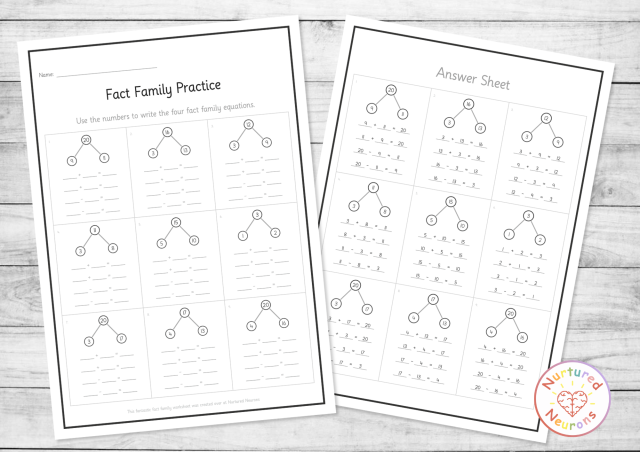
create fact family morning exercises - print off answer sheets with number sentences and fact families included! Kindergarten math center

Oh and I hope you notice the lovely font. That’s our own Early Readers font, that has been specially designed to keep the numbers clear and simple!

Well, I think that about covers it. 

Follow the instructions below to generate your own fact family practice sheets!

And if you find it useful, to help get the word out could you please give it a little share or tell someone who you think would find it useful. Thanks!

How To Use

As with all the activity makers, I really want to make them as useful as possible, so there’s a few options for you to tailor it exactly as you want!

Step 1 – Enter a Title (Optional)

Type a title into the Worksheet Title field at the top. If you leave it blank, the worksheet will use “Fact Family Practice” automatically.

Step 2 – Pick a Visual Format

Choose between three diagram styles:

  • House – the whole number sits in the roof of a house shape, with the two parts inside. The equation lines within the walls of the house below.
  • Triangle – all three numbers sit inside a triangle, with the whole at the top and the two parts near the bottom corners.
  • Part-Whole Model – three connected circles, with the whole at the top and the two parts below.

Step 3 – Set Your Number Range

Use the preset buttons to choose Within 10, Within 20, Within 50, or Within 100. This controls the maximum sum that can appear on the worksheet. If you want a specific range – for example sums between 20 and 50 only – use the custom Min and Max fields instead.

Step 4 – Choose How Many Problems

Pick 4, 6, or 9 problems per page. Four gives plenty of space for younger writers; nine is great for older or more confident learners.

Step 5 – Set Up Scaffolding (Optional)

The Equations to Pre-fill option lets you print 1 or 2 of the four equations already completed on every problem. When you choose 1 or 2, a panel appears where you check exactly which equation types get pre-printed – for example, you might always pre-fill the first addition fact and let children work out the rest.

Leave this set to 0 – All Blank if you want a full independent challenge.

Step 6 – Choose Your Toggles

  • Name Line – adds a name line at the top of the worksheet. On by default.
  • Instruction Line – prints “Use the numbers to write the four fact family equations.” below the title. On by default.
  • Answer Sheet – enables a second download button for a completed version with all equations filled in. On by default.
  • Black and White Mode – removes all color for ink-friendly printing.

Step 7 – Pick Your Colors (Optional)

Use the two color pickers to set a Border Color and a Title Color. Black and White Mode overrides both pickers if switched on.

Step 8 – Generate and Download

Click Generate Worksheet. A preview appears below showing your problems and chosen format. If you’re happy, click Download Worksheet to grab your PDF – or Download Answer Sheet if you need the completed version too. Click Make Another to reset and start fresh.

Hope your little learners enjoy making friends with their fact families!

Hooray!

The custom fact family practice sheets should look something like this:

fact family number bonds worksheet creator - printable custom pdf - fill in the blanks, fact families and number sentences

Create your Addition and Subtraction Fact Families Sheets

Hope your little learners enjoy improving their math skills – scroll down to get started! Or check out our other worksheet and game makers here.

If you can’t see the worksheet maker – it’s probably because you’re on a mobile device. You can try switching your device to landscape mode or if that doesn’t work, try again on a PC or laptop. 

Thanks!

You need to be a member to use this awesome activity maker - become a member today and get access to all of the teaching tools, plus a ready-to-go library of wonderful worksheets, awesome games, hands-on crafts and much more!

Enjoy!

custom fact family worksheet maker - create your own number bond worksheets - printable pdf

FAQ

A fact family is a set of three numbers that can be arranged into four related equations using addition and subtraction. For example, 2, 6, and 8 form a fact family because 2 + 6 = 8, 6 + 2 = 8, 8 – 2 = 6, and 8 – 6 = 2.

Fact families are typically introduced in first and second grade, so these worksheets work best for children aged 5-8. The number range and problem count options mean you can pitch the difficulty for younger beginners (Within 10, 4 problems) right through to more confident second graders (Within 100, 9 problems).

The house, triangle and part-whole model all show the same three numbers in a slightly different visual arrangement. The house is the most popular format for younger learners and makes a great introduction (they could even draw on a little chimney!). The triangle is clean and works well once children are comfortable with the concept. The part-whole model is a natural bridge for children who’ve already worked with number bonds.

Doubles only produce two unique equations rather than four – 3 + 3 = 6 and 6 – 3 = 3 – because the two parts are identical. Doubles are a great separate activity, but they’re not true four-equation fact families.

Absolutely. The easiest way is to use the number range and problem count together – Within 10 with 4 problems for children who need more support, Within 20 with 9 problems for those who are ready for more. The scaffolding pre-fill option adds another layer, letting you print 1 or 2 equations already completed for children who need a model to follow.

No – the generator picks a unique set of number combinations every time, so each problem on the page uses a different set of three numbers.


If you set a very narrow custom range that doesn’t have enough unique fact families to fill the page, the tool will show a warning and tell you how many are available. Try widening your range or reducing the problem count.

Yes – on the answer sheet, any equation that was left blank on the worksheet is shown in bold with an underline, so you can see at a glance which ones the children needed to work out themselves.

Yes – just switch on Black and White Mode before generating. All colors are replaced with greyscale, making the worksheets very ink-friendly.

For now this tool focuses on addition and subtraction, which is where most fact family teaching happens in Grades 1 and 2. If anyone really wants it I’m happy to create a multiplication and division version.

Yes – these worksheets are free to print and use with your students, whether that’s in a classroom, a tutoring session, or at home.

Access all the activities today