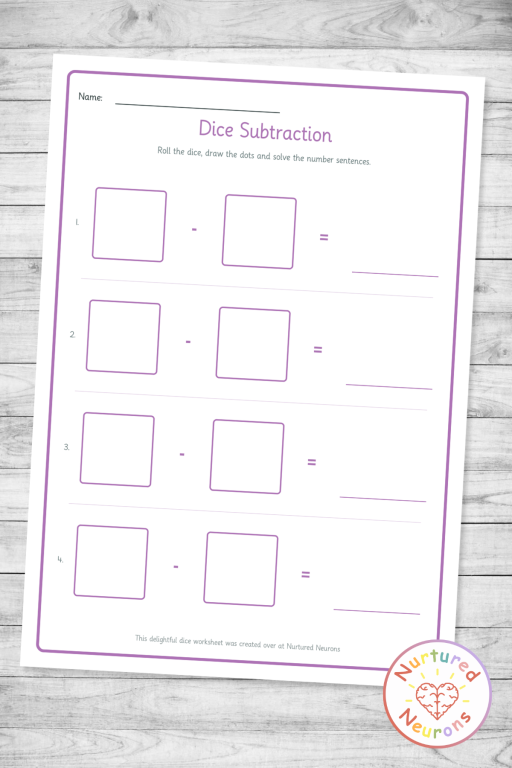
This online Roll, Draw and Solve Worksheet Maker creates custom printable dice math worksheets for Kindergarten through Grade 3. Choose 2, 3, or 4 dice per equation, pick addition, subtraction, multiplication, or division and adjust the layout - including an optional write line for changing dice faces into numerals - then download your sheets as printable PDFs.
This tool generates custom dice math worksheets in seconds. Children roll dice, draw the dot patterns they see into the squares on the worksheet and then write and solve the number sentence.
It supports all four operations, works with 2, 3, or 4 dice per equation and downloads as a lovely simple, print-ready PDF!
It pairs beautifully with our Dice Dojo Subitize and Solve (and actually is the reason I created it as I wanted a way for your little ones to record their rolls!).
Or you could always just grab a pot of dice and let your little learners go.

A number sentence is a math equation written in a line – something like 3 + 4 = 7 or 6 – 2 = 4.
The dice number sentences that your little ones will be making are the same thing, except the numbers come from rolling dice.
Here’s ho I see it working. Each blank square on the worksheet represents one die. The child rolls a real die, draws the dot pattern they see into the square, and then (if you’ve switched on the write-line option) writes the numeral below it before solving the equation.
It’s a more fun and hands on way to work on some early arithmetic and can help with a bit of subitizing as well!
They build subitizing skills alongside calculation. Every time a child looks at a die and knows it shows 5 without counting each dot, that’s subitizing! – the ability to recognize small quantities at a glance.
They help connect quantity to numerals. When the the children draw the dots then either write, or think about the number, it strengthens the link between visual quantity and symbolic math.
It’s especially important for your early learners who are still developing that connection.
They bring genuine variety to practice. Because the numbers come from real dice, no two sessions are ever the same!
The random nature of dice also makes rolling more interesting than staring at a page of pre-printed numbers.
This is one of the more basic tool here at Nurtured Neurons, but there’s still several reason why I think it’s great:
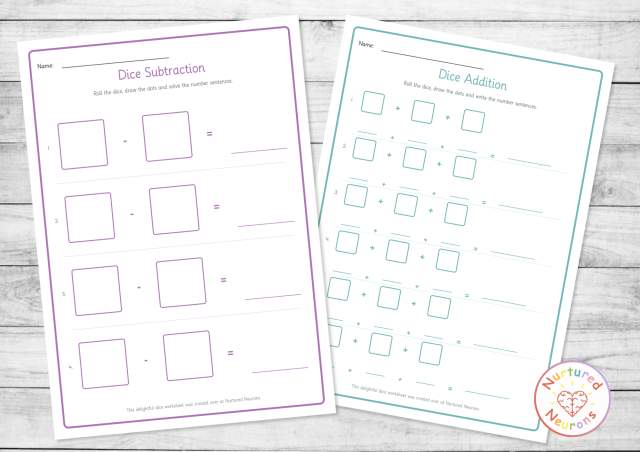
All four operations in one place. Addition, subtraction, multiplication, and division – just pick your operation and the worksheet is labeled and ready.
2, 3, or 4 dice per equation. Two dice gives you a straightforward two-number sentence. Three or four dice increases the challenge.
Fully color-themeable. You get to choose colors that you and your little ones like!
Black and white mode. One toggle strips all color from the page for ink-friendly printing on any standard printer.
Clean, classroom-ready PDF. It produces a nice clean worksheet.
Here’s a few ideas of how you could use it:
Whole-class roll-along. Open up Dice Dojo: Subitize and Solve on you whiteboard or other screen. The whole class fills in the same dice faces and solves the same number sentence. A great way to model the process and check answers as a group.
Math centers and station work. Leave a stack of worksheets at a math center with a few dice. Children work through equations independently at their own pace.
Math warm-up. A 4-equation sheet takes only a few minutes. It’s an easy, low-pressure way to start the math session.
Partner practice. One child rolls the dice, the other records and then swap. They could then check that they both come to the same result. If not, why not?
Differentiated practice within one class. Print 4 equations with 2 dice for children who still need a bit more support. Print 8 equations with 3 dice for children who are ready for more challenge.
Homework. Most families have a set of dice in a board game somewhere. So this can be a great activity for some home learning.
Quick informal assessment. A short sheet gives you a fast snapshot of how a child approaches a particular operation – whether they’re subitizing or still dot-counting.


Well, I think that about covers it.
Follow the instructions below to generate your own dice equation practice sheets!
And if you find it useful, to help get the word out could you please give it a little share or tell someone who you think would find it useful. Thanks!
As with all the activity makers, I really want to make them as useful as possible, so there’s a few options for you to tailor it exactly as you want!
Type a title into the worksheet title field, or leave it blank. If you leave it empty, the tool fills in a sensible default based on your chosen operation – “Dice Addition,” “Dice Subtraction,” and so on.
The name line is on by default, adding a “Name: ____” space at the top-left of the worksheet.
Pick 2, 3, or 4. This is how many blank dice squares appear in each row and how many dice the child needs to roll for each number sentence. Fewer dice means simpler math and larger squares on the page.
Select addition, subtraction, multiplication, or division from the buttons.
Pick 4, 6, or 8. Fewer equations mean larger dice boxes – more room for younger hands to draw dots.
Four toggles live in the Layout Options section:
The border, dice outlines, title, operation symbols and divider lines all take on your chosen color.
Click Generate Worksheet. Then click Download Worksheet PDF to save your file. If you want to change any settings, just adjust the controls and generate again – or click Make Another to reset and start fresh.
Hope your little learners enjoy rolling, drawing and solving their way through number sentences!
Hooray!
The custom dice addition practice sheets should look something like this:
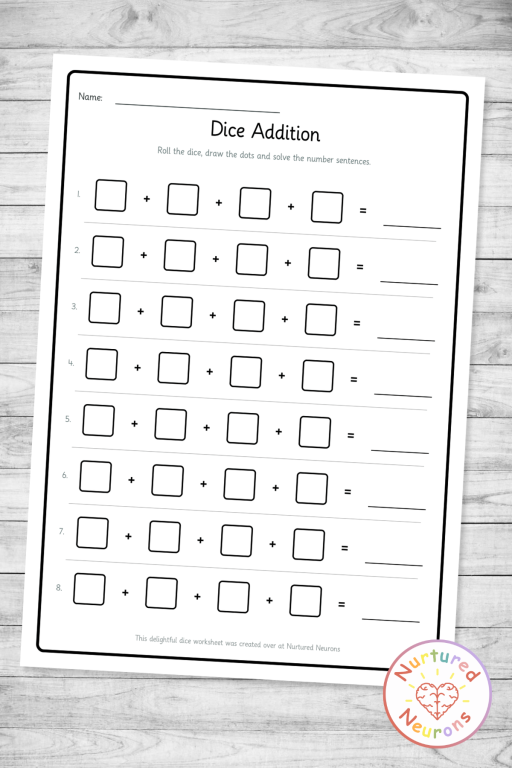


Hope your little learners enjoy improving their math skills – scroll down to get started! Or check out our other worksheet and game makers here.
If you can’t see the worksheet maker – it’s probably because you’re on a mobile device. You can try switching your device to landscape mode or if that doesn’t work, try again on a PC or laptop.
Thanks!
You need to be a member to use this awesome activity maker - become a member today and get access to all of the teaching tools, plus a ready-to-go library of wonderful worksheets, awesome games, hands-on crafts and much more!
Enjoy!


It creates printable worksheets made up of blank dice squares and a number sentence row. Children roll dice, draw the dot pattern they rolled into each square and then write and solve the equation. With the write-line option turned on, there’s also a space below each square to write the numeral before solving.
It works well from Kindergarten through Grade 3, though the real answer is: whoever it helps, use it. Younger learners and beginners do well with 2 dice, addition, and the write-line toggle on. More confident children can work with 3 or 4 dice and any of the four operations. The format scales to fit a wide range of abilities without changing the core activity.
Standard 6-sided dice – the kind you’d find in most board games – work perfectly. Each die shows a value between 1 and 6, so equations with 2 dice will produce sums within those ranges. Classroom foam dice work just as well. The dot pattern is what matters, since children are drawing what they see.
Yes! If you’re projecting to a class, you can use a digital dice roller on your whiteboard so everyone rolls together. The Dice Dojo: Subitize and Solve will work well for whole-class roll-along activities – the class all see the same rolls and fill in the same worksheet together.
Addition (+), subtraction (-), multiplication (x), and division (/). You pick one per worksheet. If you want a variety of operations across your session, just print a sheet for each or turn operations off and your children can write their own.
When the write-line toggle is on, a blank writing space and a line appear below each dice square. Children draw the dot pattern in the square and then write the numeral on the line below before solving. This translation step – picture to numeral to calculation – is especially useful for children who are still building the connection between what they see on a die and what that number looks like written down.
With 2 dice you get one operation and a simple two-number sentence – for example, 4 + 3 = ___. With 3 dice you get two operations in a chain – for example, 4 + 3 + 6 = ___ – which is more demanding. With 4 dice the chain is longer still and the numbers get larger. More dice also means slightly smaller squares on the page to fit everything across the row, so it’s worth considering your learners’ fine motor skills and confidence when you choose.
Dice rolls are always between 1 and 6, so subtraction with 2 dice can produce a negative result if the second roll is larger than the first. Whether that’s a problem depends on where your class is in their learning. You could always give your little ones a 6 as their first number so they’d never get a negative answer…
Division will often produce non-whole-number results too.
The layout is consistent for the same settings. What changes is what children put on it – because they roll real dice to fill in the squares each time, every session produces different equations. One printed sheet can be used repeatedly with different results, which makes it good value for printing.
The tool is designed for use on a PC or laptop. It may work on a tablet in landscape orientation, but some controls are easier on a larger screen. We recommend generating and downloading on a computer, then printing from there.
Yes. Turn on the Black and White mode toggle before generating and the worksheet will print with no color – clear, clean, and ink-friendly.