Create Sight Word Practice Pages with this Find and Trace the Sight Words worksheet Maker

At a Glance

This interactive Find and Trace the Sight Word Worksheet Generator creates custom printable tracing practice sheets for Pre-K through Grade 2. Choose a focus word or pick from built-in Dolch, Fry, and tricky word banks, select how many pages you need, and download a PDF instantly - a low-prep way to build automatic word recognition and early reading fluency.

About the Sight Word Worksheet Generator

You know that moment when a child can read the and said on one page… then meets the same word on the next page and suddenly forgets how their eyes work? Yep. This tool is for that.

This Find and Trace the Sight Word Worksheet Generator lets you print simple, consistent sight word tracing worksheets for the exact words your little learners are working on.

Whether that’s sight words, high-frequency words, or tricky words. 

You can:

  • Type your own focus word (perfect for intervention groups or a specific word that they’re finding extra tricky).

  • Or have this worksheet maker choose the focus words for you from a chosen set (Dolch, Fry, common exception words, etc.). Then you can either print a whole set or just a few pages – up to you.

What Are Sight Words, High-Frequency Words, and Tricky Words?

a child practices reading with her mother - maybe after she'll practice tracing some sight words

These terms often get used interchangeably and in most cases that’s probably fine, but they’re not always actually the same thing.

Sight words

Sight words are words a reader can recognize quickly and automatically. That means they don’t have to sound them out – they can just look and know what it is.

Fluent readers store words in their memory through a process sometimes described as orthographic mapping. This means your children can just look at a word and know what it is. This comes about from multiple exposures and practice.

High-frequency words

High-frequency words are simply the words that appear most often in print ( the, and, to, you, said etc). Many of these are decodable, but they show up so frequently that it’s helpful for your kids to recognize them quickly for fluent reading.

This is where lists like Fry and Dolch come in. They created word lists that are commonly used ways to organize high-frequency words for teaching and practice.

Tricky words (and “common exception words”)

In phonics-heavy settings (especially in the UK), you’ll often hear tricky words. This means words that can’t be fully decoded using the phonics that a child has learned so far.

As children learn more spelling patterns, some “tricky” words stop being tricky – hooray!

Why Find and Trace?

Find and trace is great, low-prep way to practice sight words because it combines several things together:

  • Repetition. Your children will see the focus word many times. The more times they correctly spot a word in print, the more likely they are to build that instant recognition.
  • Kids often learn better when their hands get involved
    Tracing gives them a clear, structured way to ‘feel’ as well as see how the word is formed.
  • It’s low-prep. Some of the best activites are the ones you’ll do consistently. These find and trace worksheets are great because they’re quick to explain and super easy to set up. 
  • It forces attention to letters (not just guessing). When children have to scan and decide “Is this the word or not?”, they’re paying attention to the exact letter sequence. That matters because a lot of early-reading mistakes are visual/shape guesses (mixing up was/saw, there/three, where/were, etc.).
  • It adds a “mini retrieval” every single time. For each circle they’ll need to think: “Do I know this word?”. That’s a form of retrieval practice (pulling knowledge from memory), which is a great way to build that fluency!
  • It supports early reading and writing. Win-win!
  • It’s a bit game-y. It feels more like a game than just learning the same word over and over.

Why This Tool Is Awesome

Here’s a few reasons I think you’ll enjoy using this early reading worksheet maker:

  • It’s flexible: Use it for sight words, high-frequency words, or tricky words depending on what your learners need – and you can choose exactly which word you want to focus on or auto pick from the sets.

  • It’s scalable: print one sheet or print a whole set when you need a class worth.

  • Children can start to enjoy reading more: automatic word recognition frees your children up to focus on the story and meaning, not getting stuck on “the” for the thousandth time.

  • It’s habit-friendly. It’s the kind of tool that becomes a routine. It’s quick to print, quick to do and easy to repeat.

sight word and high frequency words - worksheet tracing practice - generate custom find and trace pages for early reading and phonics practice

Oh and I hope you notice the lovely font. That’s our own Early Readers font, that has been specially designed to keep the letters clear and simple!

Well, I think that about covers it. 

Follow the instructions below to generate your own tricky word practice sheets!

And if you find it useful, to help get the word out could you please give it a little share or tell someone who you think would find it useful. Thanks!

A Note About the Word Lists

Whilst researching these sight and tricky word lists, it became obvious that there’s multiple versions of each list. At one point, it seemed like every school page I visited had a slightly different version!

So, if you think I have got a list wrong (you may well be right!), notice any words that shouldn’t be there or know that there’s a more recent version than the one I’ve used, please let me know and I’ll fix it. Thanks.

How To Use

I wanted to make the best sight word tracing generator I could, so there’s quite a few options for you to tailor it exactly as you want!

Step 1 – Choose How to Pick Your Focus Word

At the top of the tool, pick one of two modes:

  • Choose focus words for me – best for printing a batch quickly from a word list. The tool picks the focus words from whatever set you select.
  • I’ll enter the focus word – best when you’re targeting one specific word for a child, a small group, or a homework sheet.

Step 2 – If You Chose “Choose Focus Words for Me”

Select a Word Bank (like Dolch or Fry etc.) and a Level from the dropdowns. Then choose how you want the words picked:

  • Print the whole set – generates one worksheet for every word in the set.
  • Random selection – generates a random mix from the set. Use the Pages dropdown to choose how many worksheets you want. If you ask for more pages than there are words in the set, some focus words will repeat.

Step 3 – If You Chose “I’ll Enter the Focus Word”

Type your focus word into the box – use the exact spelling you want your little learners to practice. Then choose what fills the other bubbles on the worksheet:

  • Words from the selected bank/set – uses the word bank and level dropdowns to pull in distractor words automatically.
  • My own extra words – paste in your own list, one word per line.

Use the Pages dropdown to choose how many copies you need (handy if you want a class set with the same word).

Step 4 – Set Your Options

  • Focus word appears in bubbles – choose how many times the focus word shows up in the 10 word bubbles.
  • Border and accent color – click the color square to pick a color for the page border, title, and bubble outlines. Great for color-coding by group or just making things look a little more fun!

Step 5 – Generate and Download

Hit Generate PDF and your worksheet (or whole stack of worksheets) will be built and ready in seconds. Click Download Worksheet to save the PDF.

Click Make Another to reset and start fresh.

Hope your little learners love the tracing practice – and the sneaky bit of word recognition happening at the same time!

Hooray!

You may also want to check out a find and color version of this tool here or if you want to use another awesome early reading tool, you can find a phonics flashcards with sound buttons maker here.

The printed sight word practice sheets should look something like this:
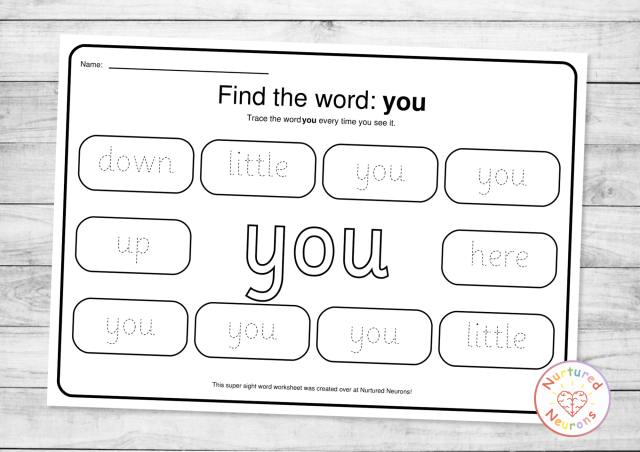
practice tracing Dolch and Fry list words - high frequency and sight words with this DIY easy to use worksheet creator

Create your Sight and High Frequency Word Practice Sheets

Hope your little learners enjoy learning to read – scroll down to get started! Or check out our other worksheet and game makers here.

If you can’t see the sight word tracing practice sheet maker – it’s probably because you’re on a mobile device. You can try switching your device to landscape mode or if that doesn’t work, try again on a PC or laptop. 

Thanks!

You need to be a member to use this awesome tool - become a member today and get access to all of the teaching tools, plus a ready-to-go library of wonderful worksheets, awesome games, hands-on crafts and more!

Enjoy!

sight word find and trace worksheet generator - make custom high frequency words worksheets - including Dolch, Fry, Common Exception words and more - find and trace the sight words - great for early reading

FAQ

It can and should be used for anyone who needs it. Having said that, people use it mainly for Pre-K through 2nd grade, plus some older children who still need some extra high-frequency word practice (especially for intervention, ELL/ESL support, or reading fluency catch-up).

As mentioned above, they overlap, but they’re not identical:

  • High-frequency words = words that show up a lot in reading and writing (the, and, to, said). Because they appear so often, learning them helps reading become smoother.

  • Sight words = words a child can read automatically “on sight”—without stopping to sound out. Many high-frequency words become sight words after enough successful practice. This process is known as orthographic mapping.

  • Tricky words = a phonics-y term (most common in the UK) for words that are not fully decodable yet based on the phonics that children have learned so far.

At the moment you can make practice worksheets for:

  • Fry sight words
  • Dolch sight words
  • Common exception words
  • Letters and Sounds tricky words
  • Red words
  • Magic Words
  • Essential Spelling Words

Both are useful. I guess it just depends what you’re trying to do.

  • Fry is based on word frequency across lots of texts, and is often used as a “big coverage” high-frequency list.

  • Dolch is an older, classroom-popular list commonly used for early grades.

If you’re a parent, it might be a good idea to contact your child’s school to find out the list they already use.

Yep. If you choose “Print the whole set”, it generates one worksheet for each word in the selected bank/set. That’s great for:

  • weekly sight word routines

  • intervention packs

  • sending home a “no-prep” practice stack

  • assesments

Then you’ll get some repeated focus words but the position of them will change.

Yes! In “I’ll enter the focus word” mode you can type the focus word, and you can even paste your own extra words if you’d rather not use a bank.

That means you can easily make sheets for the word children are struggling with – or use it for other things, like themed vocabulary or names etc.

Premade packs can be great, but a generator lets you:

  • match your exact word list

  • differentiate quickly (different words for different groups)

  • reprint the same word again later but have the focus words in different places

No, they’re often taught together. Most guidance supports teaching kids to read primarily with phonics, while also giving some focused help for tricky or high-frequency words. Teaching both can really help with fluency.

This kind of practice can really work well if it becomes a habit. Short and frequent is generally pretty good.

Some easy ways to add to your day:

  • 2–3 minutes as a morning starter

  • literacy center: “Find + Color” then read the word to an adult

  • home practice: 1 sheet a day for the week’s word(s)

  • Friday review: random selection from the last week’s words

Yep. The routine is consistent so once they know what’s happening, it’s easy to use for independent work, small groups, early finishers, or quick homework sheets.

Yes – it can support fluency by helping kids recognize common words faster, which reduces the stopping and/or guessing. High-frequency words are just that, so they show up constantly. If your children can recognize them faster, then their reading will become more fluid.

Best results usually happen when you pair it with reading real sentences and books that contain the words.

You could laminate them and use dry-erase markers. Or pop sheets into a plastic sleeves and reuse that way.

Two options, you can choose the ‘I’ll enter my own words selection’ and do it that way. 

Or you can contact me and I’ll see if I can add it.

There seems to be multiple versions of each list – some have changed over time and some schools seem to have tweaked theirs. So you’re right – our lists may not match exactly. Good thing I’ve made it so you can add your own list!

But if you do know that I have got a list wrong, notice any words that shouldn’t be there or know that there’s a more recent version that the one I’ve used, please let me know and I’ll fix it.

Access all the activities today